Why CEA 4.0 Can't Be Built on Spreadsheets
Why CEA 4.0 Can't Be Built on Spreadsheets
Designing a greenhouse in 2026 means picking one of two paths. Build your own spreadsheet and risk getting important physics wrong. Or hire a consulting engineer for several months and thousands (or more often than not, tens of thousands) of dollars, and hope the answer comes back before the project window closes.
There is very little in between. That gap - the space where a rigorous answer should be fast, affordable, and available on demand - is where most controlled-environment agriculture projects quietly get hurt.
The industry has absorbed multiple cycles of optimism and correction. CEA 4.0, the rigor-first recovery underway now, cannot run on the same design toolchain that carried each of them.
Last week we introduced Gebbora Greenhouse Simulator and explained what it does. This week we would like to explain why it needed to exist. The short version: the current toolchain for CEA design is bimodal, and both modes have real limitations that compound when a project's budget is already under pressure.
The current state: spreadsheets or consulting, pick one
Most CEA design today still runs on one of two tools.
On one end of the spectrum is the custom spreadsheet. Engineers and growers build these themselves, usually by adapting a building-energy or HVAC template to greenhouse conditions. A heat balance on the coldest design day. A cooling load on the hottest. Vendor spec sheets pasted into a summary tab. Rules of thumb layered on top of first-principles arithmetic. The appeal is obvious: it is fast, it is free, and the engineer owns every assumption.
On the other end is the consulting engagement. Typically tens of thousands of dollars and multiple months. The firm brings validated models (often Wageningen University's KASPRO, or a TRNSYS setup wrapped in custom scripting) along with methodology credibility and a written report. The appeal is also obvious: it is rigorous, it is defensible, and an investor or regulator can actually read the output.
What is missing is anything in the middle. A rigorous answer that is fast enough to iterate on, affordable enough to use at the sanity-check stage, and accessible without booking a consultant for the next quarter.
Industry observers have been saying the quiet part out loud for years. Agritecture's Henry Gordon-Smith has warned that investors "continue to back projects with fundamentally flawed assumptions": underestimated energy costs, overestimated selling prices, facilities too large for the operator's experience. That pattern has a tool-shaped root cause.
Why spreadsheets fail at greenhouse complexity
A spreadsheet can do a steady-state heat balance on a design day. What it cannot do, not without breaking and not within a tractable workbook, is run 8,760 hourly timesteps with interacting physics modules that update each other each hour.
The failure modes are predictable.
- Design-day tunnel vision. A single coldest-hour calculation cannot tell you how often your cover condenses, or how many hours per year your crop spends below minimum DLI, or how the greenhouse behaves in a shoulder season when the sun is up but the ambient air is not. The worst hour is not always the design hour.
- Linear approximations for non-linear physics. Saturation vapour pressure is exponential in temperature. Solar angles vary continuously through the year. Longwave radiation exchange depends on the fourth power of absolute temperature. A spreadsheet flattens these into cell formulas; a real greenhouse does not.
- Missing crop physiology. Greenhouse transpiration is not an HVAC latent-load calculation. The methodology that actually works (FAO-56 Penman-Monteith for reference evapotranspiration, Stanghellini's model for greenhouse-specific canopy transpiration) does not fit inside a cell formula. Peer-reviewed validation shows the Stanghellini model tracks lysimeter-measured transpiration at R² = 0.90–0.94. That is the bar. No spreadsheet approximation reaches it.
The result: a spreadsheet answers a question that is adjacent to the one you actually asked.
Why the consulting path is expensive
Consulting engagements are the other real option, and for good reason. What you are buying is not just a report: it is expert time applied to validated models that are not otherwise licensed as tools. KASPRO is not on the shelf. TRNSYS is, but using it for greenhouses requires expert scripting and a five-figure licence. The physics you need are mostly locked behind human engagements.
That is why the floor is expensive. Human time is expensive. Bespoke modelling is expensive. And the models themselves, the ones with thirty years of Wageningen validation behind them, have never been productised for self-service use.
These engagements are not the wrong answer. For projects where a stamped report is a regulatory or investor requirement, they may remain the right call. The problem is that, until recently, they were the only rigorous option.
As Wageningen's Leo Marcelis, one of the world's most-cited horticulture researchers, recently put it: "We have the tools, but I see companies where things still don't work. Why? Because vertical farming is harder in practice than on paper."
What purpose-built greenhouse simulation software actually does
The missing middle is not a generic building-energy tool wearing a greenhouse skin. It is not an academic code repository. It is a product: browser-based, documented, and priced for iterative use.
- Hourly simulation, not design-day. A full year is 8,760 hours. Purpose-built greenhouse simulation software runs that many timesteps per analysis, using real satellite climate data rather than typical-year averages. The EU Joint Research Centre's PVGIS dataset and ECMWF's ERA5 reanalysis together cover most of the world at the hourly resolution the physics requires.
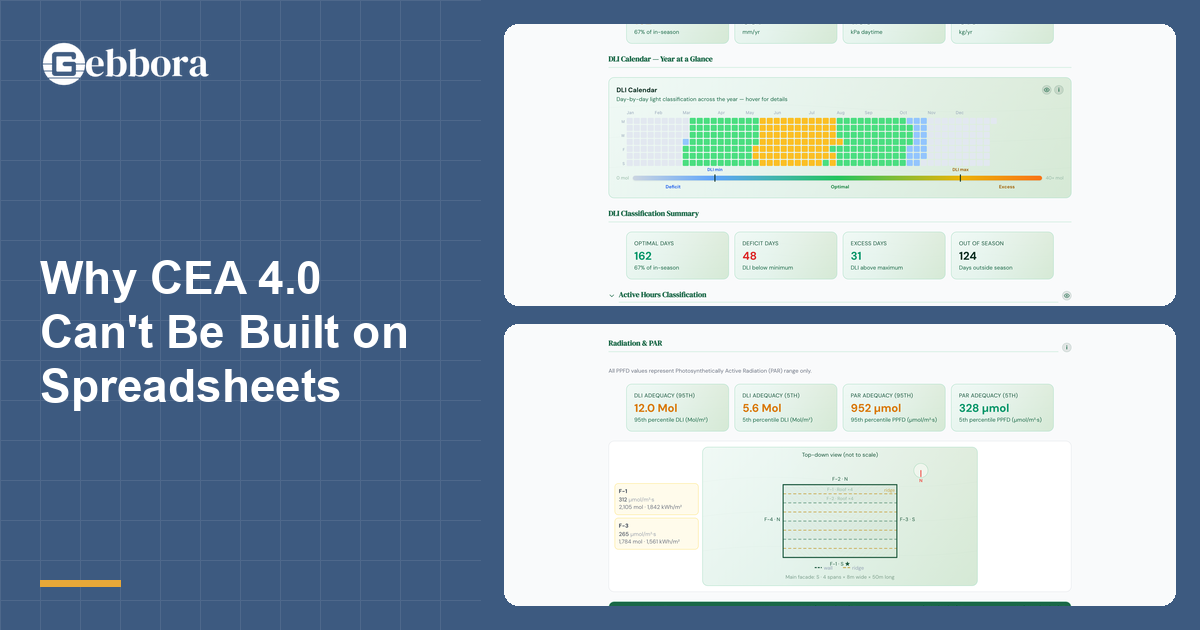
- Greenhouse-native physics modules. Multi-layer cover heat transfer. Transpiration using Penman-Monteith and Stanghellini, the methodologies the peer-reviewed literature already validated. Evaporative cooling (fan-and-pad, fog). Supplementary lighting with DLI classification. VPD. CO₂ demand. Up to four motorised shading or energy-screen layers.
- Documented equations, not black boxes. Every engine module cites its source. If the simulator computes transpiration with Stanghellini, it tells you so, and it tells you the paper. The methodology is not hidden, which is the price of being taken seriously by engineers who will be asked to defend the output.
- No install, no licence, no university affiliation. The tool runs in a browser. A feasibility sanity-check that once required a weekend of spreadsheet work or a consulting engagement now takes minutes.
The positioning is narrow on purpose. Not "the best" greenhouse design tool, and not the replacement for every consulting engagement. The tool that fits the missing middle.
Where the gap is most costly
The missing middle has a financial cost, and it is not theoretical.
- Climate equipment dominates the budget. Dr. Nadia Sabeh, the go-to HVAC specialist for CEA facilities, is blunt about this: "HVAC can be up to 40% of total CapEx and OpEx costs, especially when it's an afterthought." Industry estimates put the full set of internals (HVAC, irrigation, lighting, automation) at 40–60% of total project cost. A 20% oversizing error on climate equipment can silently swing six or seven figures on a mid-scale project.
- Capital has fled the sector. PitchBook's Q1 2023 AgTech Report found that VC investment in indoor farms fell 91% year-over-year, from $879.5M across 46 deals in Q1 2022 to $75.8M across 14 deals in Q1 2023.
- The bankruptcies were real. By end of 2025, 14 controlled-environment agriculture companies had filed for bankruptcy with combined historical funding exceeding $1.37 billion: Plenty, Bowery Farming, AeroFarms, Freight Farms, Eden Green, Vertical Future, and others. The causes were multi-factor; simulation alone would not have saved them. But the design-stage rigour that investors now expect was, for most of the last decade, unavailable to anyone without a consulting budget.
That is the cost of the gap. A generation of projects designed at the two extremes, fast and approximate or slow and expensive, with very little in between.
The self-service path
Purpose-built greenhouse simulation software exists now because it had to. The gap between spreadsheets and consulting was too wide, and too many projects fell into it.
Gebbora Greenhouse Simulator is one answer. Not the only possible one, but a concrete one. A free tier that runs the full engine suite. Hourly simulation on your actual site, with the climate data your design will actually see. Documented methodology. Browser-based. Priced for iteration, not for one-shot reports.
For the engineer who needs to size a cooling system, or the consultant who wants to sanity-check a feasibility number before submitting it, or the grower who wants to know whether the shading configuration a vendor recommended will actually hold the DLI target. That is what the missing middle looks like in 2026.
In our next post, we will go deeper on why 8,760 hours of climate data is categorically different from a design day, even when the design day is chosen correctly.
---
CEA design deserves better tools than a spreadsheet, and faster answers than a consulting engagement. That middle finally exists.