What CEA 4.0 Demands: Rigor at Every Layer of the Greenhouse Stack
What CEA 4.0 Demands: Rigor at Every Layer of the Greenhouse Stack
A cooling system gets sized for the hottest hour of a typical year. On paper it holds. The fans and pads are specified, the budget is signed, the steel goes up. Then the greenhouse runs, and the problem turns out not to be the hottest hour at all. It is the four hundred shoulder-season hours when the sun is high but the outside air is mild, the vents are doing most of the work, and the crop still drops below its daily light target because nobody simulated those hours. The equipment was correct for one hour and wrong for the year.
That gap, between the hour a design was checked against and the year it actually has to survive, is the gap CEA 4.0 is about. Controlled-environment agriculture has reached a point where the difference between a project that pencils out and one that quietly loses money is rarely the idea. It is the rigor of the engineering underneath it. This essay is the long-form case for that claim, and for the term we keep using to name it.
The industry has already lived through three cycles of optimism and correction
CEA did not arrive at rigor by choice. It arrived after repeated, expensive disappointment.
Henry Gordon-Smith, who founded the CEA advisory firm Agritecture and has watched the sector longer than most, counts the history precisely. Twelve years in, he wrote in an essay titled Why I Rebuilt Everything, means having "watched three complete cycles of optimism and correction." Each cycle followed the same arc. A technology promised to change the economics of growing indoors. Capital arrived. Facilities were built ahead of the operating knowledge to run them. The economics came in worse than the pitch deck, and the correction followed.
The first cycle was the early glasshouse-automation boom, which promised that climate computers alone would make any operator a Dutch grower. The second was the vertical-farming surge, which promised that stacking layers under LEDs would beat the field on cost per kilogram. The third was the recent CEA capital wave, which promised that scale and software would finally make the unit economics work. Each delivered real technology. None delivered the economics it sold, on the timeline it sold them.
The correction was not gentle. PitchBook reported that venture investment in indoor farms fell 91% year over year, from $879.5 million across 46 deals in the first quarter of 2022 to $75.8 million across 14 deals a year later. By the end of 2025, fourteen controlled-environment agriculture companies had filed for bankruptcy with combined historical funding above $1.37 billion, among them some of the most-funded names in the sector. The technology mostly worked. The discipline around deploying it did not keep up.
CEA 4.0 is a demand for rigor, not a new product category
In one sentence: CEA 4.0 is the discipline of making a controlled-environment agriculture project defensible at every layer of the stack, from climate data through structure, equipment, and finance to operations. It is the fourth cycle after three rounds of optimism and correction, and its single rule is that rigor is no longer optional anywhere.
The earlier cycles could survive a weak link. A facility with a brilliant climate strategy could carry a sloppy financial model for a while, because cheap capital papered over the difference. That tolerance is gone. After the correction, money is patient about good engineering and unforgiving about the rest. A CEA 4.0 project is one where the climate model, the structural design, the equipment sizing, the financial model, and the operating plan are each defensible on their own terms, and where the assumptions feeding each are written down and checked rather than inherited from a catalog.
Here is what rigor-first means at each of the five layers this essay walks through:
- Climate: retire the single design day, and simulate 8,760 real hours of site data.
- Structure: retire catalog load defaults, and derive the loads from this specific project.
- Equipment: stop sizing to the peak hour, and size to the full annual load envelope.
- Finance: drop imported averages, and build the model on full-year, locale-correct inputs.
- Operations: stop waiting for the year-end verdict; instrument with sensors and IoT to compare actual against predicted in-season and correct in small steps.
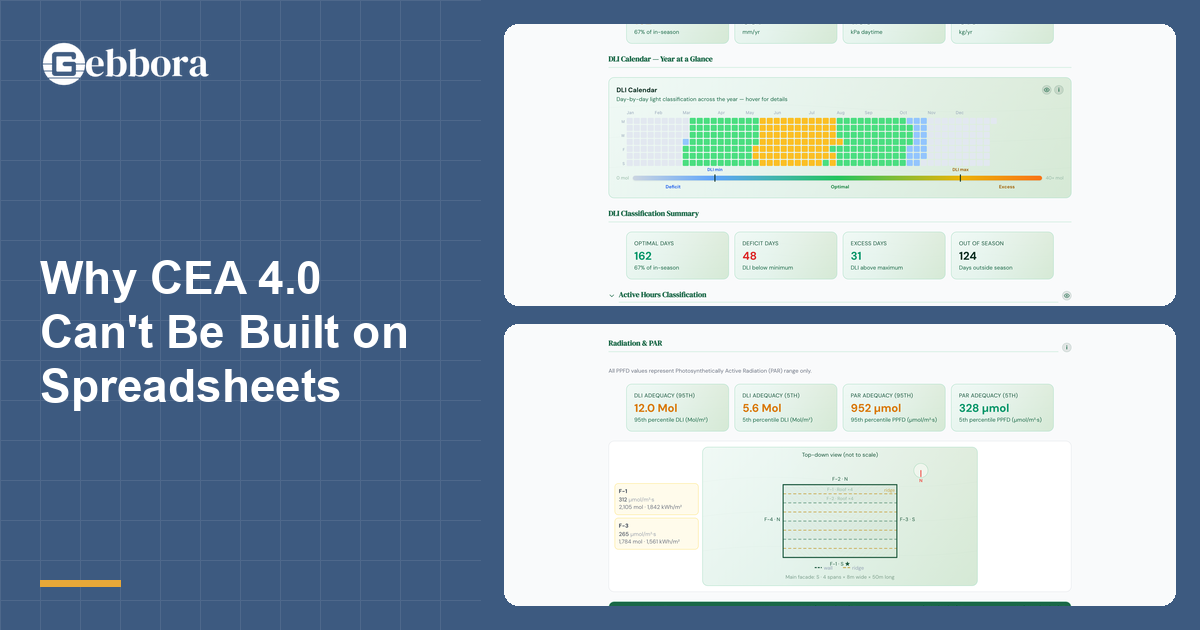
We made this argument first when we wrote about why CEA 4.0 can't be built on spreadsheets. That piece was about the tooling. This one is about the standard the tooling has to meet. The rest of this essay takes the five layers in turn.
Climate modeling on a single design day is the original shortcut
Every layer below depends on getting the climate right, and the climate is where the oldest shortcut lives.
The shortcut is the design day. You pick the coldest expected hour for heating and the hottest expected hour for cooling, you size to those two extremes, and you move on. It is fast, it is teachable, and it is wrong often enough to matter. A design day tells you nothing about how many hours a year your cover condenses, how often the crop sits below its minimum daily light integral, or how a humid shoulder season behaves when the outside air gives you no help. The worst hour and the most expensive hour are frequently not the same hour.
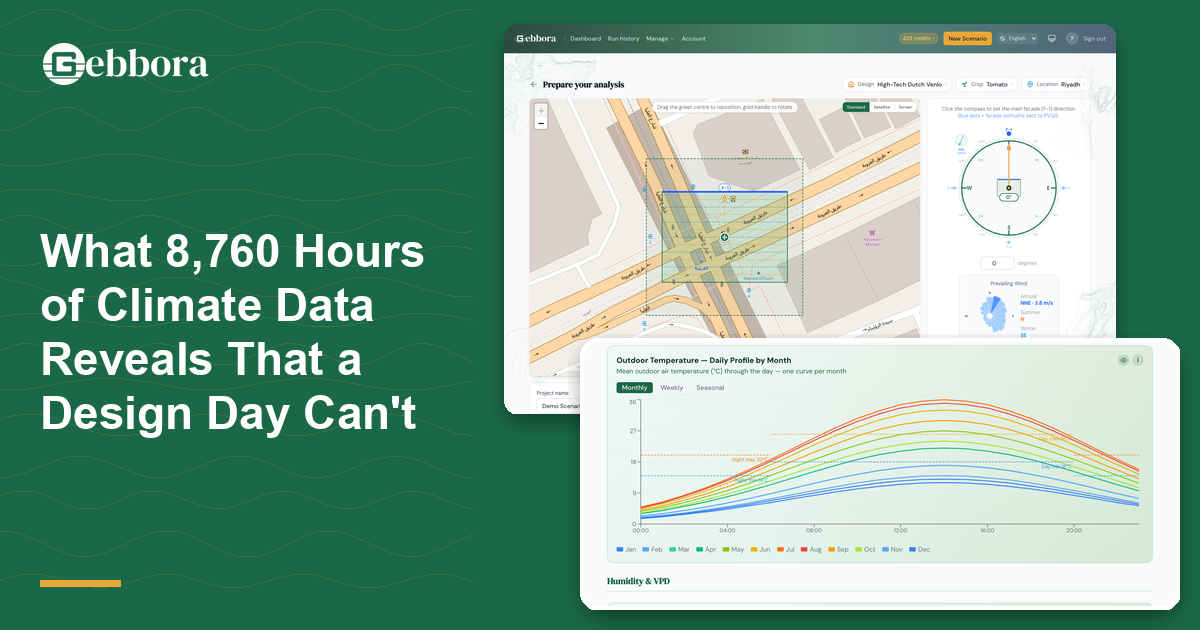
Rigor here means simulating the whole year, hour by hour, on real data. A full year is 8,760 hours, and a CEA 4.0 climate model runs all of them, using satellite and reanalysis datasets such as the EU's PVGIS records and ECMWF's ERA5 reanalysis rather than a single typical-year snapshot. The demand is concrete: replace two extreme hours with 8,760 real ones. We go deeper on exactly why this changes the answer in what 8,760 hours of climate data reveals that a design day can't. For the purposes of the stack, the point is that every number downstream inherits the error in this one. Get the climate layer wrong and the other four layers are precise about the wrong thing.
Structural loads are project-specific, and catalog defaults cost money
The structure is where rigor is easiest to skip, because the steel usually does not fail. It just costs more than it should, or less than it should, and you find out which one too late.
Greenhouse structures are quoted against standard load tables, and the temptation is to take the manufacturer's default and assume it covers you. Wind exposure, snow accumulation, the dead load of four screen layers and a lighting grid, the local building code, the specific geometry of a gutter-connected range on a particular site: these change the numbers, sometimes by a wide margin. A high-tech Dutch Venlo glass greenhouse runs roughly 2.5 to 6.2 million euros per hectare in capital cost, and 60 to 70 percent of that budget is hardware: structure, cladding, screens, and the climate equipment hanging off the frame. When the structural envelope is sized to a generic table rather than the project, the error does not show up as a collapse. It shows up as steel you paid for and did not need, or as a screen system the frame cannot actually carry, discovered during installation.
Rigor here means the loads are derived from this site, this geometry, and this equipment list, not borrowed from the nearest catalog entry. The demand is unglamorous and it is where real money leaks.
Equipment sized for the peak hour is equipment oversized for the year
The climate equipment is the single largest line a design controls, which makes it the layer where shortcuts are most expensive.
Dr. Nadia Sabeh, the HVAC specialist most CEA facilities eventually call, puts the stakes directly: HVAC can be up to 40% of total CapEx and OpEx costs, especially when it's an afterthought. Industry estimates put the full set of internals, meaning HVAC together with irrigation, lighting, and automation, at 40 to 60 percent of total project cost. When a number that large is set by a peak-hour calculation, the design optimizes for a condition that occurs a handful of hours a year and pays for it across every hour the system runs.
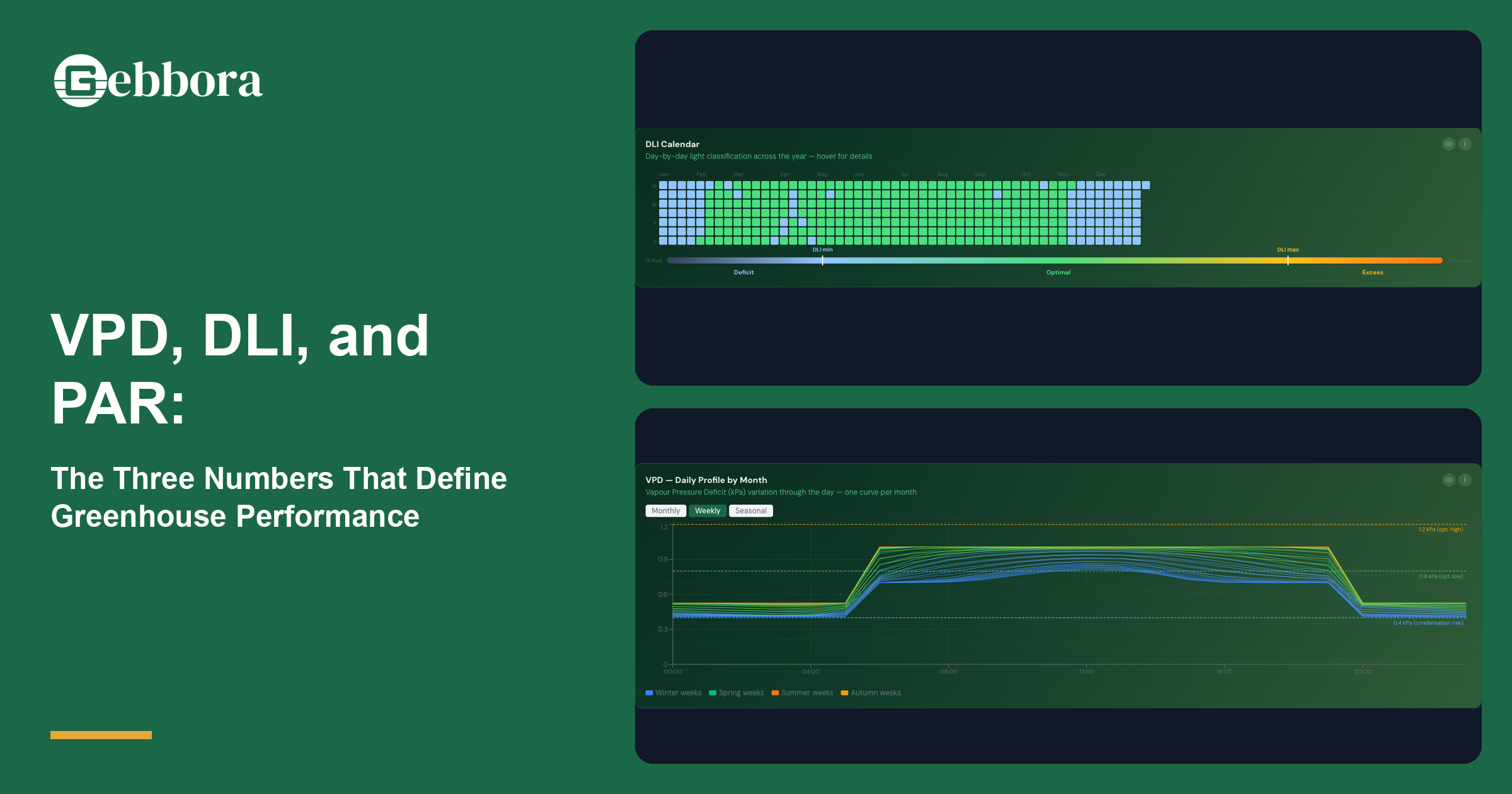
The peak hour decides whether the equipment can cope at the extreme. The other 8,700 hours decide whether the project makes money. A system sized only to the peak is usually oversized for the year, which means higher capital cost, worse part-load efficiency, and an operating bill that never recovers. Rigor here means sizing against the annual load envelope, the full distribution of hours, not the single worst one. The same hourly climate model that fixes the first layer is what makes this layer honest. If you want the physics behind why three numbers in particular, vapor pressure deficit, daily light integral, and photosynthetically active radiation, govern that envelope, we covered it in the three numbers that drive greenhouse performance.
A financial model is only as honest as its locale-correct inputs
A greenhouse is a thirty-year asset financed on a model, and the model is where optimism hides best.
The failures of the third cycle were not, for the most part, failures of technology. They were failures of assumption: energy costs underestimated, selling prices overestimated, yields projected from a research greenhouse onto a commercial one, and facilities built larger than the operator had the experience to run. A model that runs on annual averages and Western benchmarks will look healthy while every one of those assumptions quietly drifts. Move the same project to a market with informal financing, a volatile exchange rate, a different subsidy regime, and a local energy price, and a model built on imported defaults stops describing reality.
Rigor here means two things. The cashflow is built on the full year the hourly climate model produces, so the energy line reflects the hours the facility will actually run rather than a seasonal guess. And the inputs are locale-correct: the energy tariff, the labor rate, the financing terms, and the currency are the ones the project lives in, not the ones a template shipped with. The demand is that the model be defensible to someone who knows the local market, not just to someone who knows the crop.
Operations is where CEA 4.0 is still being written
The four layers above are about design. The fifth is about what happens after commissioning, and it is the layer the industry has barely started.
Leo Marcelis, who chairs horticulture and product physiology at Wageningen University and is among the most-cited researchers in the field, named the gap precisely: "We have the tools, but I see companies where things still don't work. Why? Because vertical farming is harder in practice than on paper." His remark was about vertical farming, and it generalizes. A design can be rigorous and the facility can still underperform, because what was predicted on paper is almost never checked against what the greenhouse actually does, week by week, while there is still time to act on the difference.
This is where sensors and IoT instrumentation earn their place. Probes for temperature, humidity, vapor pressure deficit, light, and CO2, together with substrate and in-canopy sensors, can stream what the greenhouse is actually doing and set it beside the performance the simulation predicted for that same week. When the two diverge, the grower learns it in days. A cooling strategy running harder than the model assumed, or a humidity band drifting toward disease pressure, is a small and cheap correction in week six and an expensive write-off in month eleven. The operations layer of CEA 4.0 is the practice of catching those gaps early and adjusting in small steps, instead of waiting a full season to learn whether the design assumptions held.
This is the frontier, not a solved problem, and it would be dishonest to pretend otherwise. It is also the direction the Gebbora platform is built to grow into: the same documented models that size a greenhouse at design time are the natural reference a monitoring layer can measure it against later. That is something we are building toward deliberately rather than claiming today. The demand at this layer, for now, is concrete and modest: instrument the facility, compare actual against predicted while the season is still running, and correct in increments rather than discovering the verdict at harvest.
CEA 4.0 is a discipline, not a vendor stack
Here is the part that matters most, because it is the part most easily misread.
CEA 4.0 is not a product you can buy. It is not a software license, a certification, or a brand, and it is certainly not ours to own. It is a discipline. A consultant running validated models by hand, an engineer who sizes equipment against a full year of hours, an investor who refuses a model built on imported assumptions: each of them is doing CEA 4.0 work, whatever tools they use to do it. The bar is the thing. Anyone who clears it qualifies, and anyone who claims the label without clearing it does not, regardless of what they are selling.
We use the term because the sector needs a name for the standard, not because we want a slogan. A name lets people point at the difference between a project that was engineered and one that was merely specified. That difference is what the last decade was expensive enough to teach.
What this means for the platform we are building
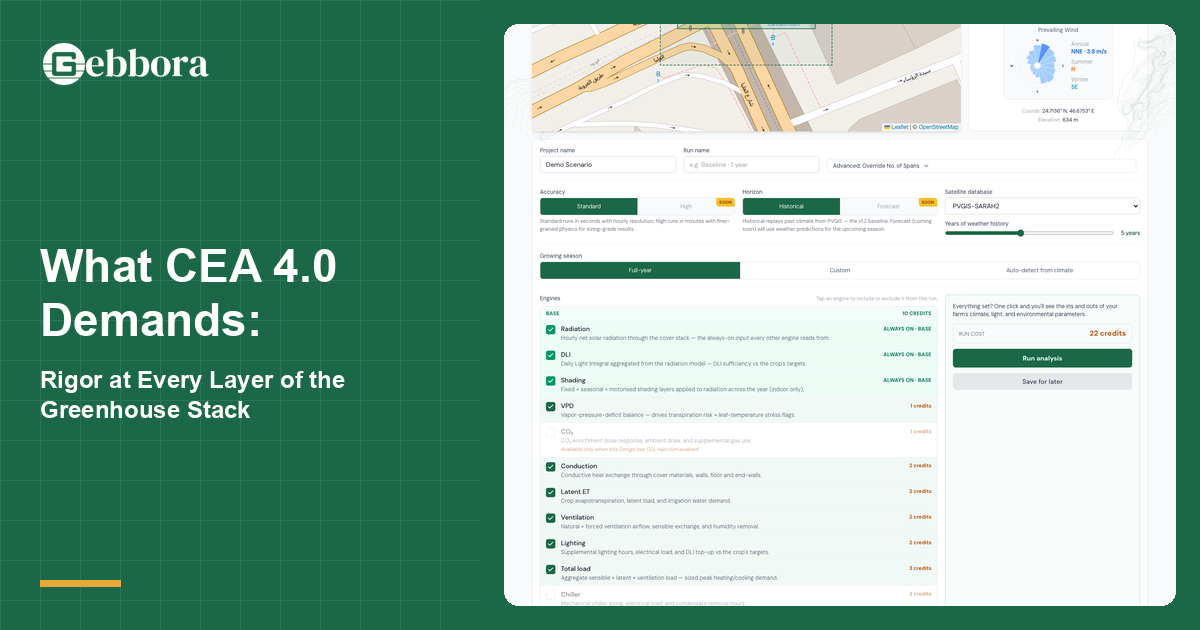
We built the Gebbora Greenhouse Simulator because the rigor this essay describes used to be locked behind either a spreadsheet that could not reach it or a consulting engagement that could, at a price most projects could not justify at the sanity-check stage. When we introduced the Gebbora Greenhouse Simulator, the argument was that purpose-built simulation could put a year of real hours, documented physics, and defensible numbers in a browser. CEA 4.0 is the standard that work is in service of.
The Simulator is the first tool on a platform we are building one layer at a time: climate and design simulation now, with structural and bill-of-quantities design, financial modeling, and field operations each in development as tools of their own. Each tool is meant to stand on its own and to answer one layer of the rigor this essay describes. You can see what is live and what is still in development on the Gebbora products page. This pillar is the map; the products are how it gets walked.
If you design, size, finance, or operate greenhouses, the bar has moved. The fastest way to see where your project stands against it is to run it.